
Understanding colour theory in makeup helps you create stunning, harmonious looks using complementary and analogous schemes. Complementary colours sit opposite each other on the colour wheel, offering bold contrast that makes features pop when used thoughtfully. Analogous schemes use nearby hues for cohesive, soft blends that suit everyday wear. By balancing these schemes with your skin tone and features, you can craft enthralling makeup styles. Keep exploring to discover how mastering these principles can elevate your beauty techniques.
Key Takeaways
- Complementary colours are opposite on the colour wheel, creating bold contrast for striking makeup looks.
- Analogous schemes use adjacent hues for harmonious, seamless blending and natural transitions.
- Combining complementary colours enhances features and adds vibrancy, while balancing intensity prevents clashing.
- Selecting colours based on skin undertones ensures cohesive, flattering makeup using these schemes.
- Using colour theory principles optimizes visual harmony and elevates overall makeup aesthetics.
Understanding the Basics of Colour Theory in Makeup

Understanding the basics of colour theory in makeup is essential because it helps you choose shades that enhance your natural features. The colour wheel is a fundamental tool, showing how different hues relate to each other. It helps you identify which colours complement or contrast your skin tone, eyes, and hair. Colour psychology also plays a role, as certain shades can evoke specific moods or feelings, influencing how others perceive you. For example, warm tones like reds and oranges can create a vibrant look, while cooler shades like blues and purples offer calmness and sophistication. Additionally, knowledge of celebrity influence can guide your choices by observing trending colour combinations used by well-known personalities.
What Are Complementary Colour Schemes?
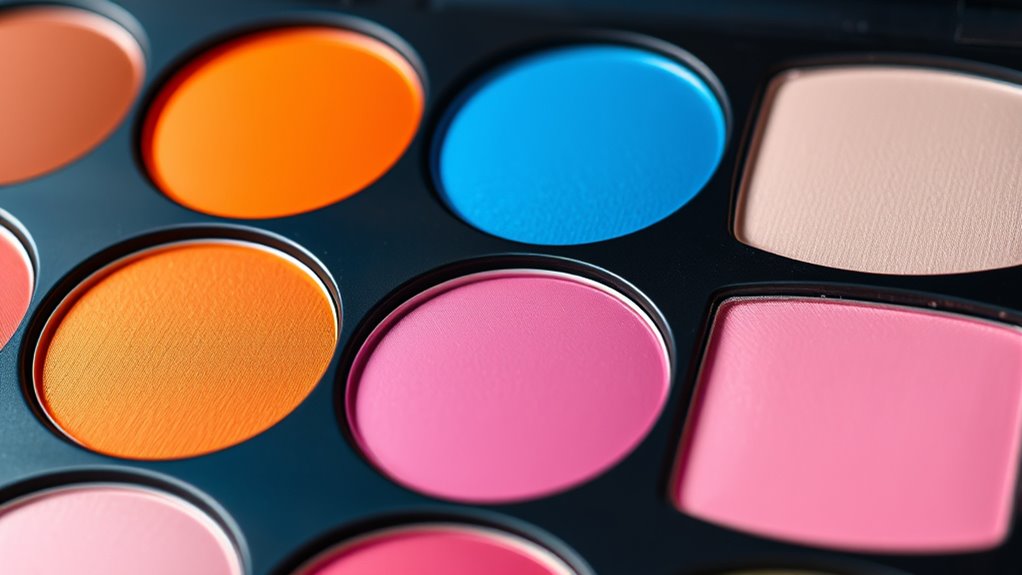
Complementary colour schemes pair colours that sit opposite each other on the colour wheel, creating striking contrasts. When you use these pairs, your makeup can enhance visual contrast and make your features pop. Mastering colour balance with complementary schemes ensures your look remains harmonious despite the bold contrasts. Additionally, understanding the contrast ratio, which influences the visual impact and balance of your makeup, can help you fine-tune your look for maximum effect. Recognizing how different colour combinations interact is essential for achieving a cohesive and vibrant appearance. Incorporating wall organization systems and other aesthetic elements can further enhance the overall visual harmony of your makeup look, ensuring a polished and coordinated style. Knowing about visual harmony can help you better balance bold contrasts with subtle shades for a more polished look.
Opposite Colour Pairing
Opposite colour pairing, also known as complementary colour schemes, involves combining colours that sit directly across from each other on the colour wheel. This pairing creates striking contrast and enhances colour harmony, making your makeup stand out. When you choose opposite colours, you intensify each hue, giving your look a vibrant and balanced feel. It’s ideal for creating bold statements or accentuating specific features. To master this scheme, consider how contrasting colours interact and how they can complement your skin tone. Experiment with different pairs to find what best enhances your natural beauty. Remember, the key is to balance the intensity so your makeup looks harmonious rather than clashy. Opposite colour pairing is a powerful tool for making your makeup pop with confidence. Additionally, understanding colour theory can help you select the most flattering combinations for your unique features. – Make sure to test your colour combinations first – Use neutral tones to tone down bold contrasts – Focus on one feature for a balanced look – Play with different shades for variety – Pay attention to your skin tone when choosing pairs
Enhancing Visual Contrast
Enhancing visual contrast with complementary colour schemes is a powerful way to make your makeup stand out. When you use colours directly opposite each other on the colour wheel, you create a striking colour contrast that instantly grabs attention. This contrast amplifies the visual impact of your look, making features like eyes or lips pop. For example, pairing blue eyeshadow with orange accents or red lipstick with green eyeliner can produce a dramatic effect. Complementary schemes help you achieve a vibrant, dynamic appearance that draws the eye naturally. Keep in mind that balancing these colours is key to avoid overwhelming your look. Incorporating color wheel principles can further enhance your understanding of how to combine hues effectively, and regularly assessing and rotating items can contribute to keeping your makeup routine fresh and balanced.
How to Use Complementary Colours for Striking Looks

To create striking makeup looks, you should thoughtfully combine colors that are opposite each other on the color wheel. Using complementary colors creates bold color contrasts that make your features pop. For example, pairing a vibrant red with green eyeshadow or a deep blue with orange accents can instantly draw attention.
Combine opposite colors on the wheel to create bold, eye-catching makeup looks that make your features stand out.
To maximize impact, try color blocking techniques—placing blocks of complementary colors side by side for a dramatic effect. Don’t be afraid to experiment with bold color combinations; they can transform a simple look into something eye-catching. Incorporating an understanding of color harmony can help you craft more visually appealing and balanced makeup designs. Recognizing how zodiac sign compatibility influences personal style can also inspire your color choices and enhance your creative expression. Additionally, paying attention to lighting conditions can ensure your makeup looks stunning in various environments.
Remember, balance is key: use one color as the main focus and the other as an accent. This approach guarantees your makeup looks are both striking and harmonious. Exploring color psychology can further refine your choices to match different moods and occasions.
- Choose a bold color as your main shade
- Use contrasting shades for eye-catching accents
- Apply color blocking for a modern twist
- Keep the rest of your makeup neutral
- Play with intensity for different moods
- Incorporate artistic expression to enhance your creative makeup approach
Exploring Analogous Colour Combinations
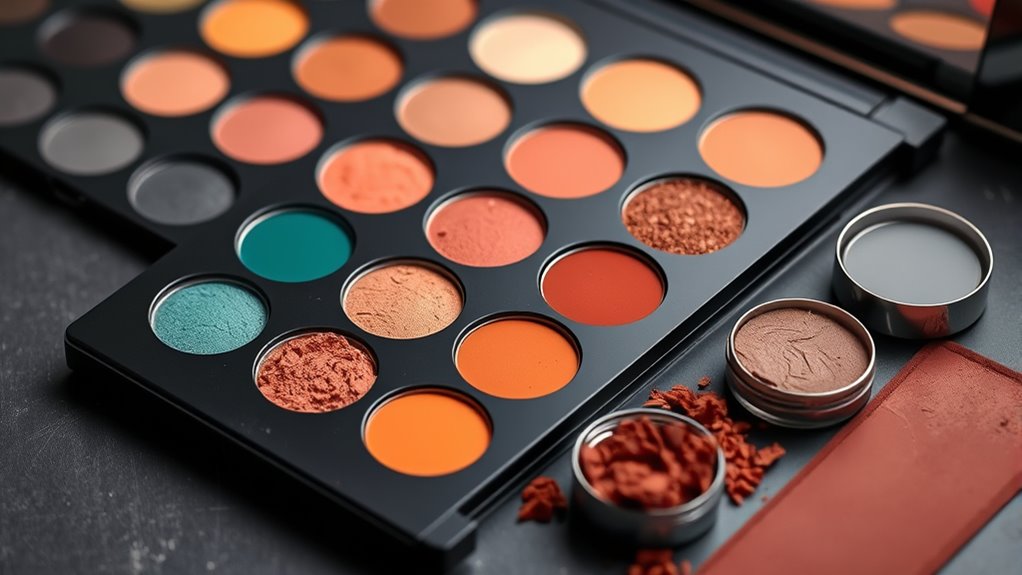
Exploring analogous colour combinations allows you to create harmonious and cohesive makeup looks. By referencing the colour wheel, you can pick shades that sit next to each other, such as blue, teal, and green. These combinations naturally blend well, producing a smooth progression between colours. Incorporating specialized attachments can help you achieve precise and seamless blending of these hues. Using analogous schemes enhances mood by evoking calmness, serenity, or energy, depending on your chosen hues. For example, warm colours like red, orange, and yellow can boost confidence and warmth, while cool colours like blue, purple, and green promote relaxation. When selecting shades, consider how they interact on the skin and how they complement your overall look. Understanding local laws can help you craft balanced, visually appealing makeup that feels unified and intentional. Additionally, understanding divorce processes may inspire you to approach transitions in your personal style with clarity and purpose. Recognizing colour theory fundamentals can further refine your ability to combine shades effectively and confidently, especially in relation to colour harmony principles that guide aesthetic balance.
Creating Harmonious Makeup With Analogous Schemes

How can you create a harmonious makeup look using analogous color schemes? Focus on seamless colour blending by choosing shades next to each other on the color wheel. Start with a base shade that matches your skin tone and build depth with adjacent colours. Incorporate colour theory, which emphasizes selecting harmonious hues for balanced looks. Shade matching is key—select colours that complement each other without overpowering. To enhance your look, consider these tips:
- Use a soft progression between shades for smooth colour blending.
- Stick to a limited palette to keep the look cohesive.
- Play with different intensities of similar hues for dimension.
- Balance vibrant shades with neutral tones.
- Keep in mind your eye and skin colour for a natural harmony.
- Recognizing how relationships can influence your personal style choices, ensuring your overall look feels authentic and expressive. Additionally, understanding colour harmony principles can help you choose the most flattering combinations. Incorporating natural elements into your makeup routine can also foster a more organic and calming aesthetic. This approach ensures your makeup feels unified, vibrant, and suited to your natural beauty.
Tips for Balancing Colour Choices in Your Makeup
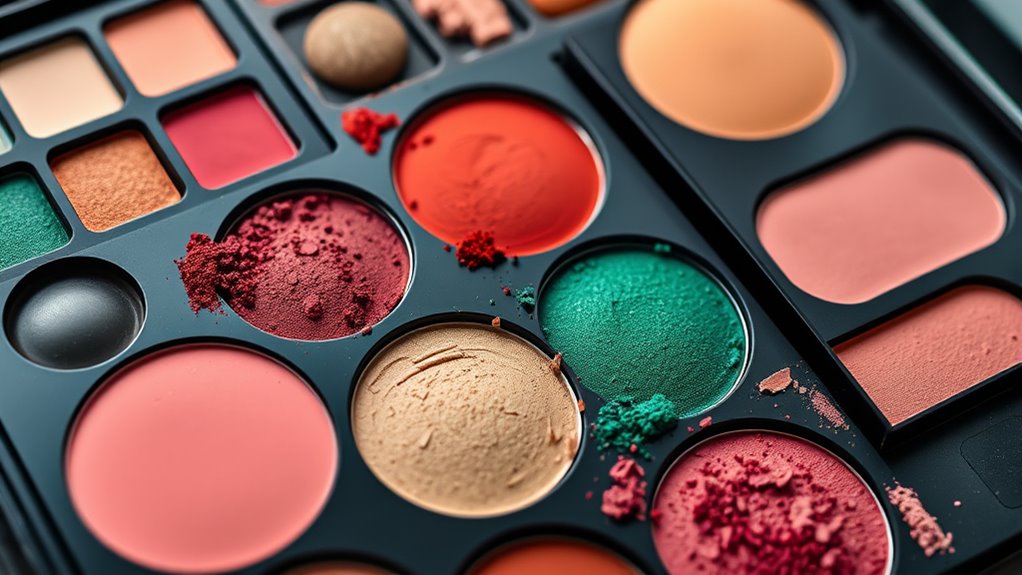
To create a balanced makeup look, start by harmonizing colors with your skin tone, so everything complements naturally.
Remember to use accent colors sparingly, highlighting your features without overwhelming your overall look.
Harmonize With Skin Tone
Matching your makeup colors to your skin tone is key to creating a balanced and flattering look. To achieve natural harmony, consider your skin undertone—warm, cool, or neutral—and select shades that complement it.
For warm undertones, opt for golden, peachy, or caramel hues. If you have cool undertones, go for blues, purples, or cool reds. Neutral undertones are versatile; you can experiment with a range of shades.
Keep these tips in mind:
- Identify your skin undertone before choosing colors
- Use warm shades to enhance warm undertones
- Cool shades work best with cool undertones
- Balance bold colors with neutral tones
- Aim for colors that blend seamlessly for a natural look
Use Accent Colors Sparingly
While choosing colors that complement your skin tone sets a strong foundation for your look, incorporating accent colors requires a careful touch. An accent color can add a pop of interest, but overdoing it can overwhelm your overall makeup. Use colour accents sparingly to highlight specific features, like a bold lip or a vibrant eyeshadow.
Limit yourself to one or two accent colors per look to maintain balance. If you opt for a striking eye, keep your lips neutral, or vice versa. Remember, subtlety often makes a bigger impact.
When selecting an accent color, consider how it contrasts with your main shades, ensuring it enhances rather than clashes. With restraint, your accent colors will elevate your makeup without overpowering your natural beauty.
Practical Examples of Applying Colour Schemes in Makeup Artistry

Applying colour schemes in makeup artistry transforms your look from ordinary to striking. To achieve this, practice shade blending to create smooth colour transitions that enhance your features.
For example, use complementary colours on the eyes for a bold effect or analogous shades for a harmonious look. Focus on seamless colour transition by gradually blending shades for a natural flow.
Experiment with different schemes to see what suits your style best. Remember, the key is balancing contrast and harmony for a captivating result.
- Use contrasting colours on the eyelids and cheeks for a vibrant pop
- Blend shades carefully for a soft, gradient effect
- Incorporate analogous colours for a subtle, monochromatic look
- Highlight and contour using complementary shades for dimension
- Play with colour placement to emphasize your best features
Frequently Asked Questions
How Do I Choose Colours That Complement My Skin Tone?
To choose colours that complement your skin tone, first identify your skin undertone—warm, cool, or neutral.
For warm undertones, opt for earthy shades like gold and bronze.
For cool undertones, try blues and purples.
Use colour contrast by selecting shades that enhance your natural hue, making your features pop.
Trust your instincts, and don’t be afraid to experiment until you find what makes you feel confident and radiant.
Can I Mix Complementary and Analogous Schemes in One Look?
Yes, you can definitely blend complementary and analogous schemes in one look. Use blend techniques to seamlessly shift between colours, creating a harmonious balance.
Start with an analogous scheme for a soft, cohesive base, then add pops of complementary colours for contrast and vibrancy. This approach enhances colour harmony while keeping your makeup dynamic and interesting.
Experimenting with blending helps you achieve a custom, eye-catching look that’s uniquely yours.
What Tools Are Best for Testing Colour Combinations Before Application?
You should use digital swatches and colour wheels to test colour combinations before applying makeup. Digital swatches let you see how shades look together on your device, giving you a clear preview.
Colour wheels help you visualize complementary and analogous schemes in real-time, so you can experiment with different pairings. These tools make it easier to choose flattering, harmonious colors, ensuring your look is well-coordinated and stunning before you even start applying.
How Do Lighting Conditions Affect the Appearance of Colours in Makeup?
Did you know that 80% of people believe makeup looks different in various lighting conditions? Lighting effects drastically influence your colour perception, making shades appear warmer, cooler, or more muted.
Natural light shows true colours, while artificial lighting can distort them, impacting your overall look. To avoid surprises, check your makeup in different lighting and adjust accordingly, ensuring your colours look flawless wherever you go.
Are There Any Cultural Considerations When Selecting Colour Schemes?
You should consider cultural symbolism and traditional colour meanings when selecting makeup colours. Different cultures associate specific colours with meanings like prosperity, mourning, or celebration.
For example, red often symbolizes luck in Chinese culture, while white may represent mourning in some Western societies. Being aware of these cultural nuances helps you choose colours that respect tradition, avoid misinterpretation, and make your makeup more culturally appropriate and meaningful.
Conclusion
So, next time you reach for those bold or subtle shades, remember: colour theory isn’t just for artists. It’s your secret weapon for flawless looks—unless, of course, you prefer chaos over harmony. Whether you choose complementary or analogous schemes, you’re in control. Who knew that mastering colour theory could turn makeup into a masterpiece? So go ahead, experiment boldly—just don’t forget that sometimes, the simplest combinations make the biggest impact.