
TL;DR

Turn your wind-down time into listening time
- Thousands of audiobooks, podcasts and originals
- Listen on your phone, tablet or Echo — also offline
- Cancel anytime
LumiMind’s LumiSleep D1 is a consumer EEG headband designed to adapt acoustic guidance in real time as users wind down, return to sleep or take a nap. The product is presented as non-pharmaceutical sleep support, not a diagnostic or therapeutic medical device, and improved sleep outcomes are not guaranteed.
LumiMind’s LumiSleep D1 is a headband that combines real-time EEG monitoring with adaptive audio to support people winding down after exercise, returning to sleep after waking, or taking a daytime nap. The device’s described approach differs from sleep trackers that primarily record data: it uses detected brain-signal changes to adjust acoustic guidance during a session, although better sleep outcomes are not guaranteed.
The system, called SleepGuide, combines two audio elements. Users select a background soundscape, such as rain or tonal music, through the LumiMind app. The headband then generates a low-frequency rhythmic pulse, called AuthenticBeats, that LumiMind says adapts in real time to EEG activity. The selected soundscape is user-controlled; the guiding rhythm is adjusted by the device.
A seven-point soft dry-electrode array records signals from the forehead without conductive gel or disposable materials, according to the product description. LumiMind says the headband processes EEG signals and generates audio on-device, rather than relying on a phone or cloud connection for that loop. The app is used to select audio and manage the experience, but a phone need not remain in use once a session starts.
For bedtime, the user positions the headband, chooses a soundscape and starts a session with one touch. The company says users can remove it when they feel drowsy or after about 30 minutes, or keep it on to monitor the transition into sleep. The product also includes a ReSleep function, started with a double-click on the physical button, and is described for use during short daytime rest periods. The source says it is not intended to diagnose or treat a medical condition.
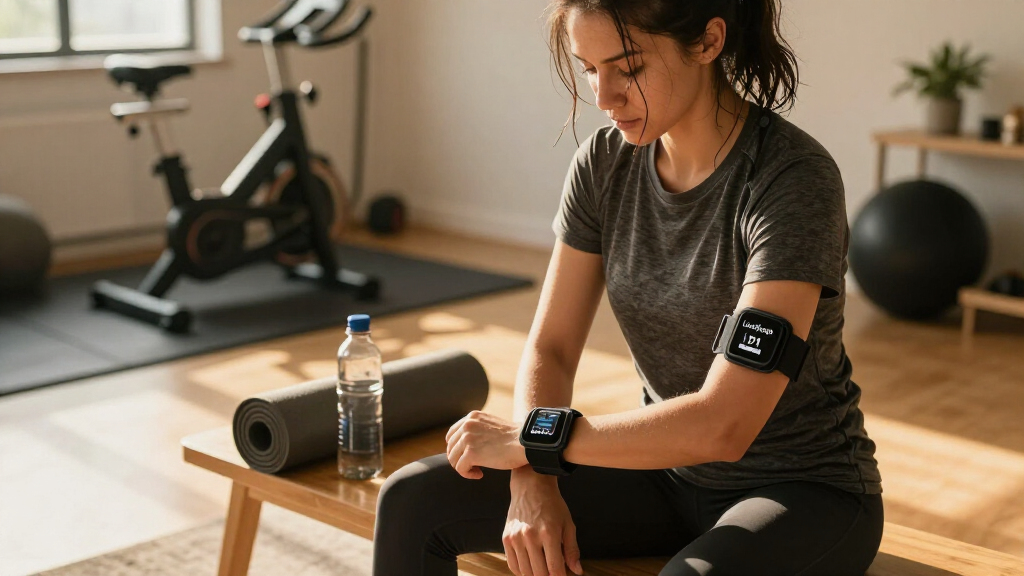
Adaptive Audio After Evening Training
For people fitting exercise around work or travel, the product is aimed at a specific gap in the bedtime routine: feeling physically tired after a late workout does not necessarily mean falling asleep promptly. A conventional tracker may give a user information about sleep, while LumiSleep D1 is designed to provide audio guidance during the wind-down itself. That distinction is the product’s central proposition, not evidence that it improves sleep.
The approach may also matter to people who wake overnight or have a limited break for a nap. A screen-free restart option could reduce the need to interact with a phone when trying to return to rest, according to the product description. But the material does not provide independent testing, clinical evidence, or measured results showing how often the system helps users fall asleep or whether it improves recovery after training. Readers should treat the stated benefits as intended uses and company claims, not established outcomes.
As an affiliate, we earn on qualifying purchases.
From Sleep Scores to Sound
The source report frames LumiSleep D1 as a move from collecting sleep data toward responding to signals as they are recorded. LumiMind calls its underlying process Real-Time Neural Coupling Modulation, or RTNCM: a continuous cycle that captures EEG signals, processes changes in brain state and generates acoustic guidance. The company says the process operates with millisecond-level responsiveness, but the source does not provide independent measurements or a study validating that performance claim.
LumiMind also says its research identified a “Sleep Onset Pattern,” which it describes as a brainwave signature associated with the natural transition into sleep. The system is designed to use that pattern as a target for adapting the sound. This explanation comes from the company’s product material; the supplied report does not include research methods, study participants, or peer-reviewed findings that would let readers evaluate the claim independently.
The hardware is described as a cushioned over-ear structure with a lightly elastic headband intended to remain in place while sleeping on the back or side. It uses near-ear air conduction, and the covered ear structure is intended to limit sound leakage. The source also reports design awards, including Red Dot, the Bronze A’ Design Award and the DNA Paris Design Awards. Those recognitions relate to design and do not establish sleep effectiveness.
“According to LumiMind, this process operates with millisecond-level responsiveness.”
— LumiMind, on its RTNCM process
As an affiliate, we earn on qualifying purchases.
Evidence, Access and Performance
The supplied material does not establish whether LumiSleep D1 has been evaluated in independent or peer-reviewed studies, or how its performance compares with other sleep products or usual bedtime routines. It also does not report measured effects on time to fall asleep, sleep duration, overnight waking, or recovery after training. Claims about the Sleep Onset Pattern and adaptive guidance should therefore be attributed to LumiMind.
Availability, pricing, shipping and campaign status are not provided in the source text, which directs readers to the company website or a Kickstarter campaign. It is also unclear how the headband performs for users with different head shapes, sleep positions, sensitivities to wearing audio hardware, or EEG signal quality. The report supplies no information about long-term use or whether users should consult a professional for sleep concerns.
sleep aid headband with EEG monitoring
As an affiliate, we earn on qualifying purchases.
As an affiliate, we earn on qualifying purchases.
Check Campaign and Product Details
The source directs interested readers to LumiMind’s website and Kickstarter campaign for further product information and a way to back the project. It does not give a launch date, funding total, delivery schedule or current campaign status, so those details should be checked directly with the company before making a purchase or backing decision.
Any clearer assessment of the product’s sleep claims would require published methods and outcome data, including independent testing. Until such evidence is available in the material reviewed here, LumiSleep D1 can be described as an EEG-linked adaptive-audio device designed for wind-down routines—not as a proven treatment or a guaranteed way to sleep better.
As an affiliate, we earn on qualifying purchases.
Key Questions
What does LumiSleep D1 do?
LumiSleep D1 is an EEG headband designed to monitor brain activity and adapt acoustic guidance during bedtime, overnight return-to-sleep sessions and daytime naps. LumiMind describes it as consumer sleep support, not a medical diagnostic or therapeutic device.
How does its audio adapt?
The user selects a background soundscape in the app. LumiMind says the device separately generates a low-frequency rhythmic pulse that responds to EEG changes detected during the session.
Can it be used after a workout or for overnight waking?
The product is described for use during a bedtime wind-down after an evening workout. Its ReSleep function is intended for restarting audio guidance after waking overnight, using a double-click on the headband’s physical button.
Is LumiSleep D1 proven to improve sleep?
Improved sleep outcomes are not guaranteed. The supplied report does not include independent clinical results or measured outcomes, and LumiMind says the product is not intended as a diagnostic or therapeutic medical device.
When will it be available, and how much does it cost?
The source material does not provide a price, release date or delivery schedule. It points readers to LumiMind’s website and Kickstarter campaign for current details.
Source: rss
Fall Picks
fall essentials
As an affiliate, we earn on qualifying purchases.