
TL;DR

Turn your wind-down time into listening time
- Thousands of audiobooks, podcasts and originals
- Listen on your phone, tablet or Echo — also offline
- Cancel anytime
Fit&Well published a home leg-workout routine built around four bodyweight exercises: squats, reverse lunges, glute bridges and lateral lunges. The report says each move lasts 30 seconds and recommends five circuits for a 15-minute session, while beginners can start with three circuits and extra rest.
Fit&Well has published a 15-minute, equipment-free leg workout built around four bodyweight moves that readers can do at home with room to move. The circuit alternates squats, reverse lunges, glute bridges and lateral lunges, with the report recommending 30 seconds per exercise and five rounds for the full session.
The routine is organized as a time-based circuit: perform each of the four exercises for 30 seconds, then rest for one minute after completing the set. The report says completing five circuits should take about 15 minutes. It does not list additional equipment; the only stated requirement is a little space to move.
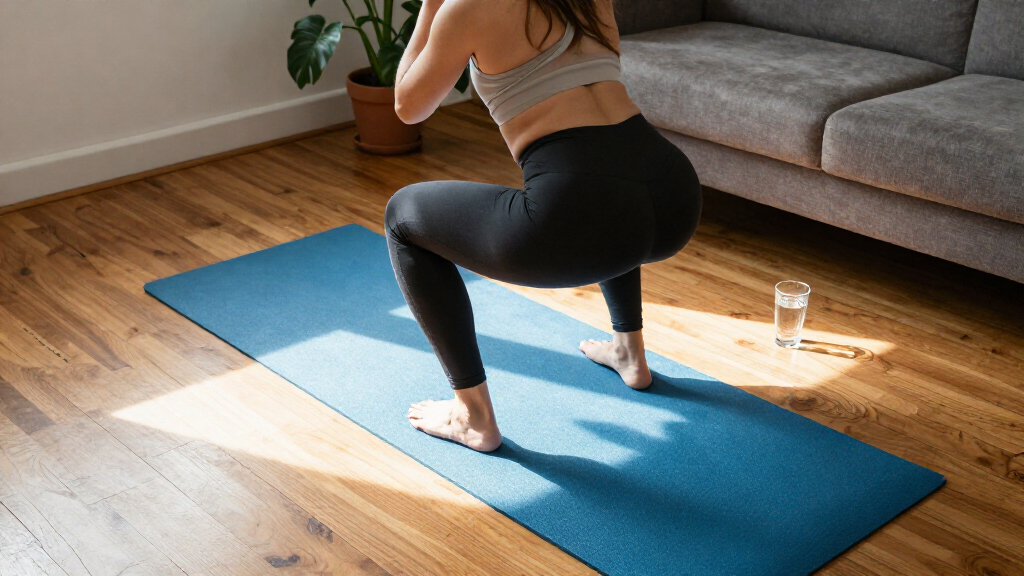
For squats, the instructions call for feet about hip-width apart, arms crossed over the chest and a controlled lowering movement by bending at the hips and knees. The report advises keeping the chest upright, the spine from rounding and the feet planted. For reverse lunges, step one foot back, lower both knees toward a right angle if comfortable, return to standing and alternate sides. The front knee should track in line with the middle of the foot.
The remaining exercises are a glute bridge and a lateral lunge. For the bridge, lie on the floor with knees bent and feet flat, lift the hips by squeezing the glutes, then lower and repeat; the report cautions against arching the lower back or letting the knees fall inward. For a lateral lunge, step to one side, bend that knee while keeping the other leg straight, then push back to the starting position and switch sides. The instructions say to keep the toes pointing forward and the chest upright.
A Short Routine With Beginner Options
The routine offers a structured home workout without equipment, which may suit people who want a short session without traveling to a gym. Its format is straightforward: four movements, timed intervals and a set rest period. The report presents the session as a way to work the lower body, but it does not provide study results or evidence quantifying strength gains.
Fit&Well says the exercises are not especially advanced but may still challenge beginners. It recommends that people new to exercise begin with three circuits and add rest between exercises, rather than starting with the five-round version. The report suggests gradually reducing rest and increasing the number of circuits as fitness and conditioning improve. These are the publication’s workout guidelines, not a personalized training assessment.
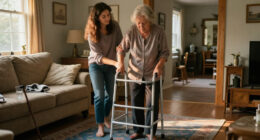
Movement options may also make the routine more accessible: the report says a chair or another solid structure can provide support during lunges for people with balance concerns, and a bed or couch can be used for glute bridges if getting down to the floor is difficult. Anyone who is unsure about technique is advised in the report to seek instruction from a personal trainer.
Products Worth Considering

Fitbit Versa 2 Health and Fitness Smartwatch with Bonus Bands

Withings Body Smart Wi-Fi and Bluetooth Body Composition Scale

Fitbit Versa Smart Watch – Black Aluminum, One Size (S & L Bands Included)
As an affiliate, we earn on qualifying purchases.
How the Four-Move Circuit Works
The source is a Fit&Well exercise report titled “Build a stronger lower body at home with this 15-minute equipment-free leg workout.” Its first-person introduction describes using the routine on days when the writer cannot get to a gym. The supplied material does not identify the writer or give a publication date, so neither is specified here.
The suggested five-round timing follows from the published structure: each round contains four 30-second exercises, followed by a one-minute rest after the circuit. That makes each round about three minutes, including the stated rest, and five rounds about 15 minutes. Beginners are directed to do fewer circuits and rest more, so their session may take longer depending on their pace and breaks.
The report includes form pointers for each move, but the supplied source material does not include independent testing, a comparison with other workouts or measured outcomes. It should be read as a published exercise routine, not as evidence that a particular result is guaranteed.
“All you’ll need to do the routine is a little bit of space to move—no equipment required.”
— Fit&Well report
Evidence and Individual Fit
The supplied report does not state when the workout was published, identify the author or provide independent evidence showing how much strength or muscle change participants might achieve. Its description of the routine as a way to build the lower body is the report’s framing; no outcome data or guarantee is provided.
It is also not clear whether the routine is suitable for every reader, since the source does not assess individual health, injuries, mobility or training history. Its general form cues and modifications may not address every need. The report advises beginners to seek guidance from a personal trainer when they need help with technique and tells readers to stop if they experience sharp pain and speak with a doctor.
Adjusting the Routine Over Time
The report suggests beginning with three circuits and extra rest if the full five-round session feels too demanding. As a person becomes stronger and better conditioned, it says they can gradually reduce rest and add circuits. It does not set a fixed progression schedule or specify a target pace beyond the 30-second intervals.
Readers following the routine should use the instructions as general guidance, adapt the range of motion to what feels comfortable and use support for balance if needed. The supplied material does not announce a follow-up study, a new version of the workout or another scheduled development; the next step described is simply adjusting the number of rounds and rest periods over time.
Key Questions
What exercises are in the 15-minute workout?
The circuit includes squats, reverse lunges, glute bridges and lateral lunges. Each move is performed for 30 seconds before moving to the next.
How many rounds make up the full session?
Fit&Well recommends five circuits, with a one-minute rest after each completed circuit. The report estimates that this takes about 15 minutes.
How should beginners modify the workout?
The report recommends starting with three circuits and adding rest between exercises. It also suggests using a stable chair or structure for support during lunges if balance is an issue.
Does the workout require equipment?
No equipment is listed as necessary. The report says participants need a little space to move; it suggests a bed or couch as an alternative surface for glute bridges if getting onto the floor is difficult.
What should someone do if an exercise causes sharp pain?
The report says to stop immediately if sharp pain occurs and speak with a doctor. It also advises beginners who need help with form to consult a personal trainer.
Source: fitandwell.com