
TL;DR

Turn your wind-down time into listening time
- Thousands of audiobooks, podcasts and originals
- Listen on your phone, tablet or Echo — also offline
- Cancel anytime
Researchers at Nottingham Trent University and Integrated System Technologies developed and tested a home-monitoring prototype combining radar, thermal sensors and smart plugs. In a mock home, data from the sensors worked better together at identifying movement and posture, but the study does not establish how reliably the system detects real emergencies or performs in occupied homes.
Nottingham Trent University researchers and technology company Integrated System Technologies have developed and tested a home-monitoring prototype that combines radar, thermal sensors and smart plugs to track activity without cameras or wearable devices. The team says the system could alert caregivers to unusual behavior, but its reported testing took place in a mock domestic environment, not a long-term trial in older people’s homes.
The prototype uses millimeter-wave radar to detect movement, low-resolution thermal sensors to identify posture, and smart plugs to register patterns in the use of household appliances. The researchers say the combined data can help the system learn a resident’s usual routines and identify activity that differs from those patterns. Examples might include prolonged inactivity or an absence of expected household tasks.
The thermal sensors are designed to distinguish actions such as sitting, standing, walking and lying down without recording facial features. Their output is kept highly pixelated, according to the research description. Smart plugs, connected to ordinary appliances and Wi-Fi, can provide signals related to everyday activities such as making a drink or preparing food.
The team tested the sensors in a mock home arranged in six room layouts, including bedrooms and living areas with different furniture. Researchers recorded a series of activities and assessed how well the system identified movement and posture. They reported that combining the sensor inputs improved performance compared with relying on individual technologies, but the source report does not give detailed accuracy figures or demonstrate clinical detection of specific emergencies.
Monitoring Without Cameras or Wearables
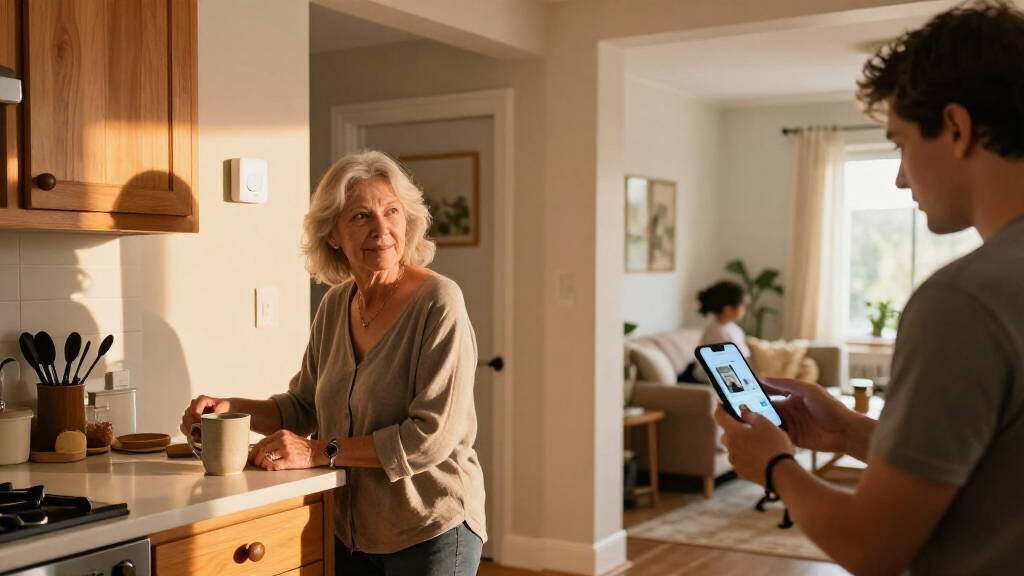
For older adults who want to remain at home, a system that can flag changes in routine could offer another way for family members or care professionals to check on someone without continuous video monitoring or requiring the resident to wear a device. The research team says alerts could prompt a remote check-in or an in-person visit if the system detects a possible emergency or unusual pattern.
The potential benefit is not yet the same as proven emergency detection. Radar, posture and appliance-use signals may help identify changes, but the reported work does not establish whether the prototype can reliably distinguish a fall or serious illness from ordinary variations in activity. Its practical value will depend on performance in real homes, how alerts are reviewed, and whether the technology is acceptable to the people it is intended to support.
As an affiliate, we earn on qualifying purchases.
How the Prototype Combines Sensors
The study, titled “Privacy-Preserving Ambient Sensing for Activities of Daily Living: Multimodal Radar-Thermal Human Activity Recognition and Smart Plug Appliance Recognition,” was published in the journal Sensors in 2026. The research involved Nottingham Trent University (NTU) and Integrated System Technologies Ltd.
According to the report, the system’s artificial intelligence combines sensor readings and learns an individual’s behavior patterns over time. That design is intended to spot deviations, including changes in mobility, sleep-related patterns or normal appliance use. NTU researcher Dr. Yangang Xing said the approach aims to support older people who wish to stay in their own homes rather than move into residential care. Those are intended uses; the reported test was a prototype evaluation in a simulated domestic setting.
“This technology aims to support the growing number of older adults who wish to remain in their own homes for longer, rather than moving into residential care.”
— Dr. Yangang Xing, lead researcher from NTU’s School of Architecture, Design and the Built Environment
privacy-focused home activity monitor
As an affiliate, we earn on qualifying purchases.
As an affiliate, we earn on qualifying purchases.
Real-World Performance Still Unknown
The available report does not provide accuracy rates, false-alert rates or results from long-term use in the homes of older adults. It also does not say whether the prototype has been tested during actual falls, strokes, heart attacks or other medical emergencies. The researchers describe these as events the system is intended to help identify, not outcomes confirmed by the mock-home evaluation.
It is also unclear how the system would handle differences between residents, changes in household routines, connectivity problems or sensor failures. The report does not specify a commercial launch, price, regulatory status, or how residents would control data sharing and caregiver notifications. These questions matter because missed alerts and unnecessary alerts could both affect trust and care decisions.
As an affiliate, we earn on qualifying purchases.
Further Testing and Deployment Questions
The reported next step is not specified in the source material. Before the system could be judged as a dependable support tool, further evaluation would need to establish how it performs in varied, occupied homes and whether it can identify concerning changes reliably over time. Testing should also clarify how alerts are sent, who responds, and what safeguards protect residents’ privacy and data.
For now, the findings are evidence that combining radar, thermal sensing and smart-plug data improved performance in the team’s mock-home tests. Whether that translates into safer independent living, dependable emergency alerts or a product ready for routine care remains unconfirmed.
As an affiliate, we earn on qualifying purchases.
Key Questions
What does the home sensor system use?
It combines millimeter-wave radar, low-resolution thermal sensors and smart plugs to track movement, posture and patterns of appliance use.
Does the system use cameras or wearable devices?
The prototype is described as operating without intrusive cameras or wearable devices. Its thermal output is highly pixelated and is intended to avoid showing facial features or personal identity.
Has it been shown to detect real medical emergencies?
Not in the testing described in the report. The researchers tested activities in a mock domestic environment; reliable detection of real falls, strokes, heart attacks or other emergencies has not been established there.
Could it help older people remain at home longer?
That is the team’s intended potential use, with alerts to caregivers when behavior appears unusual. The reported findings do not show that the prototype has extended independent living in a real-world study.
When will the system be available?
The source report does not announce a release date, price or commercial availability. Further details about development and real-home testing have not been provided.
Source: rss
Columbus Day / Indigenous Peoples' Day Picks
long weekend sales
As an affiliate, we earn on qualifying purchases.