
TL;DR

Turn your wind-down time into listening time
- Thousands of audiobooks, podcasts and originals
- Listen on your phone, tablet or Echo — also offline
- Cancel anytime
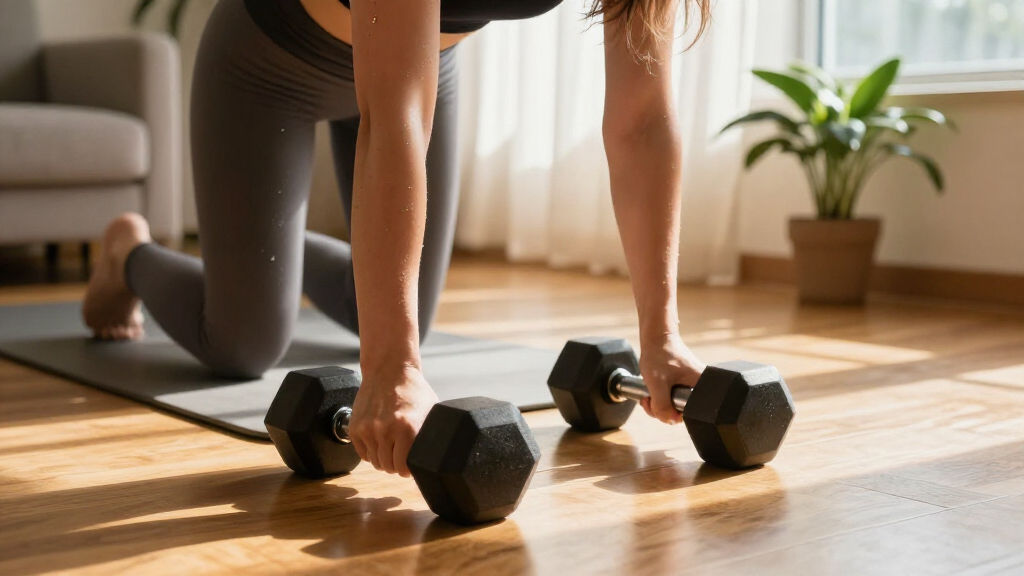
Personal trainer Pippa Sealey says shorter rest periods and unilateral exercises can make home dumbbell workouts more challenging when heavier weights are not available. A Fit&Well report outlines a workout combining those approaches, but it does not provide evidence that the routine suits every fitness level or guarantees continued progress.
Personal trainer Pippa Sealey recommends two ways to make home dumbbell sessions more challenging without buying heavier weights: shorter rest periods and unilateral exercises, which work one side of the body at a time. A Fit&Well report sets out a routine using those methods, aimed at people already comfortable with basic movements such as squats and deadlifts.
Sealey said she uses shorter rests and unilateral movements when she does not have access to heavier loads at home. One way to limit rest is a superset: perform one set of an exercise, then move straight to a different exercise before taking a break. She also suggests agonist supersets, which pair exercises that target the same muscle group.
The report’s workout combines supersets and tri-sets, or sequences of two or three exercises completed before resting. It lists three rounds for each exercise group. The first group includes deficit calf raises, hamstring bridge marches and a 60-second wall sit; the second pairs single-leg Romanian deadlifts with split squats. Later groups include push-ups and a single-arm dumbbell row, followed by core exercises such as side-plank hip lifts and dumbbell pull-throughs.
Most movements are prescribed for three sets, with repetitions varying by exercise. The workout specifies 60 to 90 seconds of rest after some sequences, while listing no rest between exercises within those sequences. The report also describes a single-arm dumbbell push press, though the provided workout overview does not clearly show where that movement fits in the sequence.
Making Lighter Weights More Challenging
For people training at home with a limited set of dumbbells, Sealey’s suggestions offer ways to change a session without purchasing additional equipment. Working one side at a time changes the exercise demands while using the same weight, and shorter rests increase the pace of a workout. The report presents these as training strategies, not as a guarantee of continued strength gains.
The approach changes exercise selection and sequencing rather than relying only on adding weight. The routine includes single-leg exercises, multiple exercise sequences and movements that require balance and control. Sealey’s stated audience is people already confident with fundamental exercises, rather than beginners learning those movements for the first time.
adjustable dumbbell set for home workouts
As an affiliate, we earn on qualifying purchases.
As an affiliate, we earn on qualifying purchases.
The Workout’s Intended Audience
The report frames the workout around a common limitation of home strength training: a person may begin with a pair of dumbbells but later find that repeating the same load no longer feels challenging. Sealey’s proposed adjustments change how exercises are performed and sequenced rather than requiring heavier equipment.
Unilateral exercises include movements such as a single-leg Romanian deadlift and a split squat. The report’s instructions call for controlled repetitions and balance, including keeping the hips level during the single-leg hinge. Supersets, meanwhile, reduce the interval between paired movements; the full rest period comes after the sequence is complete. These details matter because “shorter rest” does not mean every exercise should be rushed or performed without control.
““You may also want to use more agonist supersets.””
— Pippa Sealey, as quoted by Fit&Well
non-slip exercise mat for strength training
As an affiliate, we earn on qualifying purchases.
As an affiliate, we earn on qualifying purchases.
Limits of the Published Guidance
The report does not provide research evidence comparing this routine with other training methods, or data showing how much it may improve strength. It also does not specify the dumbbell weights used, how long participants should follow the workout, or how to adjust the exercises as they become easier. The source does not establish that shorter rests or unilateral movements are appropriate for every reader.
There is also an apparent gap in the workout listing: its overview includes push-ups and single-arm rows, while the exercise instructions provided include a single-arm push press without a clearly matching place in that overview. Readers should consult the original report for its complete exercise sequence. The material does not give individual guidance for people with injuries, health conditions or specific training needs.
resistance bands for home strength training
As an affiliate, we earn on qualifying purchases.
As an affiliate, we earn on qualifying purchases.
How Readers Can Use the Routine
Readers can review the complete workout instructions and compare the listed movements with their experience and available equipment. Sealey’s stated target audience is people who already know fundamental exercises such as squats and deadlifts. The report does not announce a follow-up study, new program or scheduled update.
The source emphasizes controlled form, including maintaining balance during single-leg exercises and stopping push-ups when good technique can no longer be maintained. The article does not prescribe a progression plan or a universal rest schedule beyond the intervals listed for specific groups. Individual adaptations are not addressed in the report.
Key Questions
What are the trainer’s two suggested ways to make home dumbbell workouts harder?
Sealey recommends shorter rest periods and unilateral movements, which work one side of the body at a time. She also describes supersets as one way to structure shorter rests.
What is a superset in this workout?
A superset means completing a set of one exercise and then a set of another exercise before resting. An agonist superset pairs exercises that target the same muscle group, according to Sealey.
Who is the workout designed for?
The Fit&Well report says it is designed for people who are already confident performing fundamental movements such as squats and deadlifts. It is not presented as a beginner’s introduction to strength training.
Does the routine require heavier dumbbells?
The two strategies are presented as ways to increase the challenge without buying extra equipment. The report does not specify a required dumbbell weight or promise that the routine will produce the same results for everyone.
Are shorter rests and one-sided exercises right for everyone?
The source does not say that they are. The workout includes balance-demanding and controlled movements, and the report does not provide personalized advice for people with injuries, health conditions or differing fitness levels.
Source: rss
Halloween Picks
halloween
As an affiliate, we earn on qualifying purchases.