
TL;DR

Turn your wind-down time into listening time
- Thousands of audiobooks, podcasts and originals
- Listen on your phone, tablet or Echo — also offline
- Cancel anytime
Fit&Well published a beginner-friendly Pilates routine designed to take 10 minutes and require no equipment. Instructor Andrew Griffiths recommends six movements and suggests doing the routine three times a week, with a rest day between sessions.
Fit&Well has published a 10-minute Pilates routine for beginners that requires only floor space and no equipment. The six-movement sequence, created by Pilates instructor Andrew Griffiths, is intended to build core control and stability while giving newcomers a structured introduction to the Pilates exercise style.
The routine begins with pelvic tilts, performed on the back with knees bent, for eight to 10 repetitions. It then moves to the Hundred, with a beginner option to keep the head and shoulders on the floor and the feet grounded. Griffiths says beginners can start with 40 or 50 arm pulses, rather than aiming immediately for 100.
The middle of the workout pairs two sets of dead bugs—eight to 10 repetitions per side—with two sets of glute bridges, at 10 to 12 repetitions. The dead bug calls for alternating an arm and opposite leg while keeping the lower back connected to the floor. In the bridge, participants lift their hips without over-arching the lower back. The source lists 30 seconds of rest between sets for these exercises.
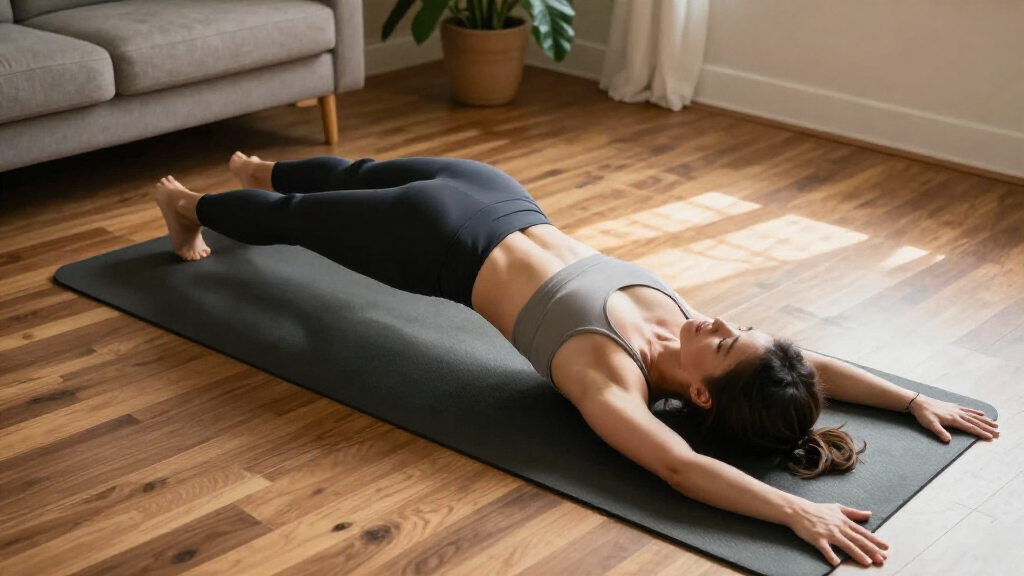
The sequence continues with two sets of bird dogs, eight to 10 repetitions on each side, then finishes with a 30-to-60-second child’s pose. Griffiths recommends practicing the workout three times weekly with a day off between sessions. He says the routine can be progressed when it begins to feel easy, but the source does not prescribe a particular next level.
A Short Routine With Built-In Options
The workout offers beginners a short, equipment-free starting point for practicing controlled trunk and hip movements. Its modifications—including keeping the feet down during the Hundred and leaving the head on the floor—let participants scale parts of the routine, rather than treating the full version as a requirement.
Griffiths says the exercises target different parts of movement control: he identifies the Hundred, dead bug and bird dog as work for the core and muscles that stabilize the spine, while the bridge and bird dog engage the glutes and muscles supporting the back. These are the instructor’s explanations of the routine’s intended focus, not reported findings from a study testing this specific six-exercise sequence.
For readers seeking a simple schedule, the recommendation of three sessions a week with recovery days gives a practical starting structure. The source does not provide evidence that this exact frequency produces a particular amount of strength gain, and results will depend on individual circumstances and consistent practice.
beginner Pilates mat non-slip extra thick
As an affiliate, we earn on qualifying purchases.
As an affiliate, we earn on qualifying purchases.
How the Six Moves Fit Together
The routine moves from small, supine movements to exercises that challenge coordination, then ends with a resting position. Pelvic tilts introduce awareness of how the pelvis moves; dead bugs and bird dogs add alternating arm-and-leg actions that require control. Bridges add hip extension, while child’s pose provides a gentle finish.
Griffiths describes Pilates as combining breathing with deliberate movement. He also says the breathwork may help with stress and anxiety. Those are attributed claims in the Fit&Well report; it does not cite research measuring mental-health effects from this specific workout.
The piece frames the routine as suitable for people who have not tried Pilates before. It does not state that the exercises are designed to treat pain or a medical condition, and it offers no individualized assessment or clinical guidance.
“Small and controlled is the aim. The movement comes from the pelvis, not the legs.”
— Andrew Griffiths, Pilates instructor and fitness expert cited by Fit&Well
Pilates mat for home workouts with carrying strap
As an affiliate, we earn on qualifying purchases.
As an affiliate, we earn on qualifying purchases.
Limits of the Workout Guidance
The Fit&Well report does not specify when the article was published in the supplied material, and it does not cite a trial or other evidence evaluating this exact workout. The promised outcomes—such as improved strength, stability or posture—are presented as the routine’s aims and Griffiths’s explanations, not as guaranteed results.
It is also not clear how the routine should be adapted for people with injuries, pain, mobility limitations or other health concerns. The source gives limited modifications for the Hundred but does not provide alternatives for every exercise or individualized safety advice.
beginner Pilates workout guide book core exercises
As an affiliate, we earn on qualifying purchases.
As an affiliate, we earn on qualifying purchases.
Practice, Recovery and Progression
The source recommends repeating the sequence three times a week, leaving a day between sessions, and progressing when it feels easy. It does not set a timeline for that progression or name specific harder variations. Beginners can follow the listed movement cues and use the provided easier option for the Hundred rather than forcing a position that feels too challenging.
People with pain, an injury or health concerns should seek guidance from a qualified health or fitness professional before starting or changing an exercise routine. The report does not provide a personalized assessment.
Key Questions
Does this Pilates workout require equipment?
No. Fit&Well says the routine requires only floor space and takes about 10 minutes.
Which exercises are included?
The six movements are pelvic tilt, the Hundred, dead bug, glute bridge, bird dog and child’s pose.
How often does the instructor recommend doing it?
Andrew Griffiths recommends doing the routine three times a week, with a day off between sessions. This is his guidance in the Fit&Well report, not a personalized prescription.
Can beginners modify the Hundred?
Yes. The report says beginners can keep their feet on the floor and leave their head and shoulders down. Griffiths says 40 or 50 pulses can be a starting point if 100 feels too challenging.
Does the report prove the routine will improve posture or reduce back strain?
No. Griffiths describes how he believes the exercises support core control, glute strength and posture, but the report does not cite research testing this exact routine or establish guaranteed outcomes.
Source: rss
Halloween Picks
halloween
As an affiliate, we earn on qualifying purchases.