TL;DR

Turn your wind-down time into listening time
- Thousands of audiobooks, podcasts and originals
- Listen on your phone, tablet or Echo — also offline
- Cancel anytime
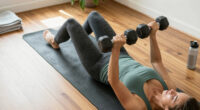
A Fit&Well writer tried carrying two 10kg dumbbells between rooms whenever she moved around her home, continuing the habit for two weeks. She reported less neck stiffness, easier grip-dependent tasks and a side-plank time 15 seconds longer, while stressing that the experiment cannot show the carries caused those changes.
A Fit&Well writer says she felt less neck stiffness, found some grip-heavy tasks easier and improved her timed side plank after carrying two 10kg dumbbells between rooms for two weeks. The personal experiment suggests one way to add movement to a desk-bound day, but it does not establish that the carries alone caused the changes.
The writer adapted an idea shared on Instagram by personal trainer Kate Rowe-Ham, who suggested leaving weights at the bottom of a staircase and carrying them upstairs on trips between floors. Rowe-Ham credited nutrition consultant Laurel Seabrook with a version using a 25lb kettlebell. Because the writer rarely went upstairs while working, she moved her dumbbells between her kitchen desk and living room instead.
For two weeks, she carried the pair of 10kg dumbbells whenever a task took her between those rooms, then returned them on the next trip. She said the repeated carries gave her a reason to get up, walk and pay attention to her posture. By the end, she reported that her neck felt less stiff and that she felt taller and stronger, while acknowledging that she could not attribute those feelings to the carries alone.
She also said the weights felt easier to hold by the end of the first week. In the second week, she noticed she could manage a couple more repetitions than usual in exercises where grip often tired first, and found heavy grocery bags easier to carry. Her timed side plank increased from 1 minute 33 seconds on the first day to 1 minute 48 seconds after two weeks. That is a 15-second difference in her own test, not evidence of a general training effect.
A Small Habit, With Limits
The report is relevant to people seeking ways to break up long stretches of sitting without setting aside a separate workout. The writer describes using ordinary trips between rooms as prompts to stand, walk and carry a load, rather than treating the activity as a measured training program.
Her experience is a single-person account, however, and includes no comparison period or control group. Changes in posture awareness, grip performance or plank endurance could have other explanations, including normal variation or other activity. The results are best read as observations from one experiment, not proof that carrying weights between rooms will produce the same outcomes for others.
As an affiliate, we earn on qualifying purchases.
From Stair Trips to Room Trips
The original suggestion involved placing weights by a staircase and carrying them up and down during trips between floors. That turns a routine movement through the home into a brief loaded walk, commonly called a farmer’s carry when weights are held at the sides. The Fit&Well writer changed the setup to suit her work pattern, carrying weights between two rooms instead.
Her report describes a two-week trial, not a formal study. It gives the dumbbell weight and the two side-plank times, but does not quantify how many carries she completed each day or the total distance and time spent carrying. Those details limit how closely readers can compare the routine with their own activity.
As an affiliate, we earn on qualifying purchases.
What the Trial Cannot Show
The report does not say how often the writer carried the weights, how far she walked on each trip, or whether she changed anything else in her exercise routine during the same two weeks. It also does not describe repeated side-plank tests or standardized testing conditions. As a result, the 15-second difference may reflect a real change in her performance, but the report cannot isolate its cause.
It is also unclear whether other people would notice similar changes. The source documents one person’s experience and provides no broader participant group or independent measurements. The writer’s account of reduced stiffness and easier carrying should not be taken as a guarantee or a medical finding.
As an affiliate, we earn on qualifying purchases.
The Writer Plans to Continue
The writer said she plans to keep adding the carries to her day and may try single-arm carries to track how she progresses. The report does not give a date for a follow-up or say whether she will repeat the side-plank test under the same conditions.
Any future account would remain a personal update unless it included a larger, controlled assessment. For now, the reported experiment ends with the writer’s intention to continue; further results are not yet available.
As an affiliate, we earn on qualifying purchases.
Key Questions
What did the writer do?
For two weeks, she carried two 10kg dumbbells between her kitchen workspace and living room whenever she had a task that took her between the rooms.
What changes did she report?
She described less neck stiffness, easier grip-dependent tasks and a side-plank time that rose from 1:33 to 1:48. These are observations from her own experiment, not results established for other people.
Does the report prove the carries caused the changes?
No. The writer said she could not determine how much the carries contributed, and the report did not include a control group or other methods to isolate cause and effect.
How did the idea start?
The Fit&Well report says personal trainer Kate Rowe-Ham shared a suggestion to carry weights up and down stairs during ordinary trips, crediting nutrition consultant Laurel Seabrook with a version using a kettlebell. The writer adapted it for trips between rooms.
Will there be a follow-up?
The writer said she intended to continue and might add single-arm carries. The report does not provide a schedule or confirm that another update will be published.
Source: rss
Halloween Picks
halloween
As an affiliate, we earn on qualifying purchases.