
TL;DR

Turn your wind-down time into listening time
- Thousands of audiobooks, podcasts and originals
- Listen on your phone, tablet or Echo — also offline
- Cancel anytime
Researchers reported that sphingomyelin C24:0 in exhaled breath condensate distinguished fibrotic hypersensitivity pneumonitis from idiopathic pulmonary fibrosis in a study presented at the CHEST meeting. The results are preliminary: few participants provided breath samples, and the test needs external validation before its accuracy or clinical usefulness is established.
Researchers reported that a lipid found in exhaled breath condensate may help distinguish fibrotic hypersensitivity pneumonitis from idiopathic pulmonary fibrosis (IPF), two conditions that can be difficult to tell apart in advanced disease. In the study presented at the CHEST meeting in Phoenix, sphingomyelin C24:0 correctly predicted fibrotic hypersensitivity pneumonitis in 80% of cases and IPF in 85.7%; the finding is preliminary and requires external validation.
The test measured sphingolipids in exhaled breath condensate, a sample made by cooling and collecting moisture from a patient’s breath. The study included 101 participants who provided blood samples: 28 healthy controls, 33 people with IPF and 40 with fibrotic hypersensitivity pneumonitis. Breath samples were available from smaller groups: 10 controls, 21 people with IPF and 18 with fibrotic hypersensitivity pneumonitis.
Sphingomyelin C24:0 in the breath samples had an area under the receiver operating characteristic curve (AUC) of 0.897, a measure of how well a test separates groups. A blood measure, plasma dihydrosphingosine, had an AUC of 0.737 on its own. Combining the blood and breath measures produced an AUC of 0.906, only slightly higher than the breath result alone, according to the report.
Jon Mullholand, MD, of Virginia Commonwealth University presented the findings. He said the two diseases can share clinical, imaging and pathological features in late-stage disease. The report says the conditions differ in management and prognosis, making accurate classification consequential. The study results do not establish that the test improves treatment decisions or patient outcomes.
A Possible Clue From Exhaled Breath
The results point to a possible noninvasive way to support diagnosis when clinicians are trying to distinguish two fibrotic lung conditions with overlapping features. That distinction can matter because treatment approaches and expected disease courses differ. A test that reliably adds useful information could help clinicians make decisions when existing evidence is difficult to interpret.
For now, the study shows a signal in a limited set of breath samples, not a ready-to-use clinical assay. Its reported predictive performance should not be treated as proof that the test can replace current diagnostic assessment. Researchers would need to reproduce the result in independent patients and establish how it performs alongside the clinical, imaging and pathology information doctors already use.
exhaled breath condensate lung test kit
As an affiliate, we earn on qualifying purchases.
As an affiliate, we earn on qualifying purchases.
Why Breath Samples May Differ
Sphingolipids are a class of molecules involved in processes including inflammation and fibrosis. Earlier research has reported altered sphingolipids in IPF. Mullholand said breath condensate may reflect conditions closer to the lung itself, while blood measurements can capture broader changes across the body.
In the study described in the report, blood samples showed more changes among people with IPF. Breath-condensate results from those with IPF were comparatively similar to controls, while levels in fibrotic hypersensitivity pneumonitis were more elevated. Mullholand characterized that condition as a more localized pulmonary inflammatory state. These observations offer a possible explanation for why the breath marker separated the groups, but do not establish the biological cause of the differences.
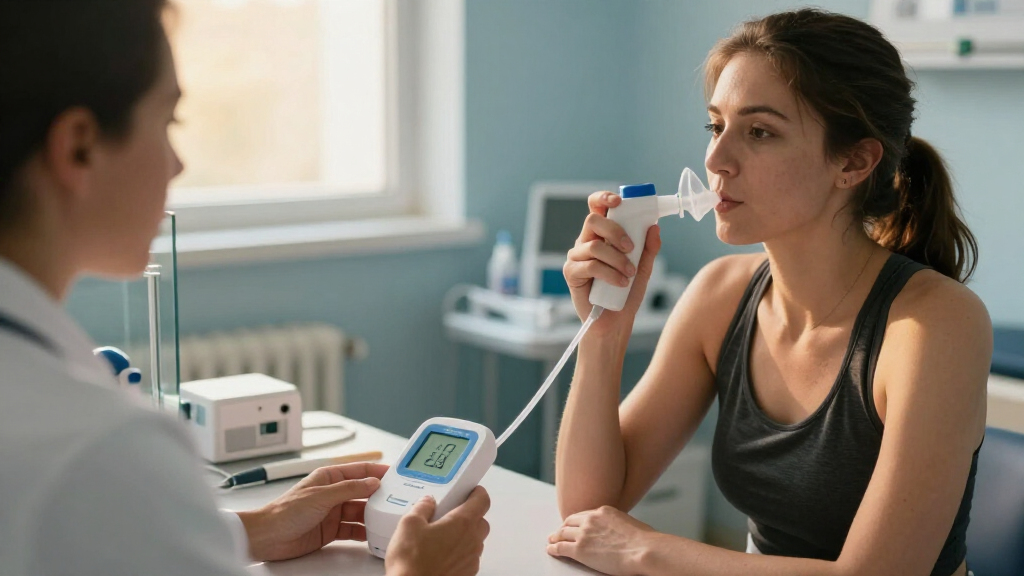
Collecting condensate involves breathing into a device that cools exhaled moisture so it can be retrieved for analysis. Mullholand said collection can take 15 to 20 minutes and may be difficult for people with severe lung disease. The report also notes that these tests are not widely available: plasma sphingolipid testing is not a common assay, and many U.S. laboratories do not accept breath condensate for analysis.
“There’s a diagnostic challenge when we’re trying to differentiate these [two conditions] at end-stage disease, as they can have overlapping clinical presentations as well as imaging features, even pathologic slides.”
— Jon Mullholand, MD, of Virginia Commonwealth University, speaking at the CHEST meeting
fibrotic lung disease diagnostic tools
As an affiliate, we earn on qualifying purchases.
As an affiliate, we earn on qualifying purchases.
Validation and Practical Limits
The reported accuracy comes from a study in which only 49 participants provided breath samples, including 21 with IPF and 18 with fibrotic hypersensitivity pneumonitis. The source report does not provide enough detail to determine how the predictive performance would hold up in a separate patient population or across different clinical settings. External validation is still needed.
It is also unclear how the test would fit into routine diagnosis, what thresholds would be used, and whether results would change clinical decisions. The report does not describe a standardized, widely available assay or establish that breath testing improves outcomes. Collection time, difficulty for people with impaired breathing and limited laboratory access are additional barriers. The findings are a research result, not a recommendation to use the test in place of established clinical evaluation.
As an affiliate, we earn on qualifying purchases.
Independent Testing Needed
The next reported step is external validation in an independent group of patients. Such work would need to test whether the breath marker continues to distinguish the diseases, how reliably it performs, and whether it adds useful information to current diagnostic methods. The report does not give a timeline for that study.
Researchers may also investigate the biological role of the measured sphingolipids and whether changes are part of the disease process or a consequence of it. Before clinical adoption, laboratories would need a workable and consistent method for collecting and analyzing breath condensate, with studies addressing the challenges of testing people with advanced lung disease.
sphingomyelin breath analysis device
As an affiliate, we earn on qualifying purchases.
As an affiliate, we earn on qualifying purchases.
Key Questions
What did the breath test measure?
It measured sphingomyelin C24:0, a sphingolipid, in exhaled breath condensate collected by cooling moisture from a person’s breath.
How well did the marker distinguish the conditions?
In the reported study, it correctly predicted fibrotic hypersensitivity pneumonitis in 80% of cases and IPF in 85.7%. The breath measure’s reported AUC was 0.897. These results need independent validation.
Can patients get this test now?
The report says breath-condensate analysis is not accepted by many U.S. laboratories, and plasma sphingolipid testing is not a common assay. The findings do not indicate that the test is routinely available for clinical diagnosis.
What needs to happen before the test could be used in care?
Researchers need to confirm the results in an independent study and determine whether the test adds reliable information to existing diagnostic assessment. Collection and laboratory methods would also need to work consistently in clinical settings.
Source: rss
Fall Picks
fall essentials
As an affiliate, we earn on qualifying purchases.