TL;DR

Turn your wind-down time into listening time
- Thousands of audiobooks, podcasts and originals
- Listen on your phone, tablet or Echo — also offline
- Cancel anytime
A Fit&Well report draws attention to power, the ability to produce force quickly, as a fitness skill that may receive less attention than strength training for women in midlife. Trainer Kylie Hansen suggests a four-move routine, with easier modifications and short sets focused on controlled, purposeful repetitions.
Fit&Well has highlighted power training—the ability to produce force quickly—as a fitness skill that can be overlooked in advice for women in midlife, and published a four-move routine from trainer Kylie Hansen. Hansen says practicing controlled, quick movements may help people respond to everyday situations that require speed, such as recovering balance after a stumble; the report does not present evidence that the routine itself extends lifespan.
Hansen, a NASM-certified personal trainer and coach at Busy Bariatrics, distinguishes power from strength by focusing on how quickly force can be produced. In the report, she says muscle fibers involved in fast, powerful movements can decline with age and inactivity. That explanation is attributed to Hansen; the source does not provide a study, data on the rate of decline, or a direct measure of longevity outcomes.
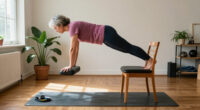
Her suggested routine includes a burpee, squat jump and squat to upright row, followed by a plank dumbbell pull-through. The first three movements practice producing force quickly with the whole body or lower body. The pull-through is different: it challenges the participant to keep the torso and hips steady as weight shifts between arms. Hansen recommends two or three sets of five to six repetitions for each exercise, with 60 to 90 seconds of rest between sets; the pull-through is done for five to six repetitions per side.
The report describes ways to scale the exercises. A burpee can be performed by stepping the feet back rather than jumping, and a squat jump can be made easier by rising onto the toes without leaving the floor. The plank pull-through can be performed from the knees. Hansen advises prioritizing controlled, purposeful repetitions over exhaustion, saying fatigue can reduce power. The source does not specify how often to do the workout or provide individual exercise screening.
Why Quick, Controlled Movement Matters
Power can support movements that call for a fast response, rather than simply the ability to lift or push a heavy load. Hansen points to catching oneself after a trip and moving quickly to regain balance as examples. Those are practical reasons the skill may matter to people as they age, although the report does not show that this specific routine prevents falls or improves survival.
The distinction also changes how a workout is performed. Power-focused sets are not intended as a high-repetition cardio circuit in Hansen’s guidance: when fatigue accumulates, the quality and speed of movement may drop. Rest periods and modest repetition counts are part of her approach, alongside modifications that allow participants to reduce impact. Readers should treat the routine as general fitness reporting, not an individualized program or a guarantee of health outcomes.
As an affiliate, we earn on qualifying purchases.
Strength Is Not the Whole Picture
The report places power alongside the better-established emphasis on strength training in discussions of exercise and aging. Its central point is not that strength work should be replaced, but that producing force quickly is another ability that can be practiced. Hansen describes power as using strength at speed and links it to coordinating movement as well as generating force.
The four exercises reflect that framing: the burpee combines upper- and lower-body actions, the squat jump emphasizes lower-body propulsion, and the squat to upright row coordinates standing with an upper-body pull. The plank dumbbell pull-through adds a stability challenge rather than an explosive jump. The routine and its exercise instructions come from Hansen, as presented by Fit&Well; the source material does not include independent testing or comparative results.
“That means being able to use your strength at speed—a skill that matters when you need to catch yourself after a trip or move quickly to regain your balance.”
— Kylie Hansen, as quoted by Fit&Well
As an affiliate, we earn on qualifying purchases.
Evidence and Personal Fit
The source does not identify a research study establishing how much power women lose in midlife, how quickly any change occurs, or whether the exercises described reduce falls or improve longevity. The report presents Hansen’s explanation and workout recommendations, not clinical findings. It also does not give a publication date, an exercise frequency, or guidance tailored to people with injuries, balance difficulties, or other health conditions.
It is therefore unclear how well the routine suits any particular reader without information about their experience, mobility, and health. The listed modifications reduce some movement demands, but the article does not claim they make every exercise appropriate for everyone. People considering changes to exercise should consult a qualified professional for advice suited to their circumstances.
explosive exercise equipment for women
As an affiliate, we earn on qualifying purchases.
As an affiliate, we earn on qualifying purchases.
How Readers Can Use the Routine
Fit&Well’s report provides a set of exercises and a suggested structure, but it does not announce a follow-up study or further expert guidance. Its immediate takeaway is Hansen’s coaching approach: choose an appropriate modification, perform a small number of deliberate repetitions, rest, and stop treating the movements as a race against fatigue.
Readers who want to try the routine can review the step-by-step instructions in the original report and decide with a qualified fitness or health professional whether the movements are suitable for them. Any broader conclusion about power training’s effects on longevity would require evidence beyond the workout advice provided here.
balance and stability training for women
As an affiliate, we earn on qualifying purchases.
As an affiliate, we earn on qualifying purchases.
Key Questions
What does power mean in exercise?
Trainer Kylie Hansen defines power as the ability to produce force quickly—using strength at speed. It differs from simply measuring how much force someone can produce.
Which exercises are in the suggested routine?
The routine includes a burpee, squat jump, squat to upright row and plank dumbbell pull-through. The first three focus on producing force quickly; the pull-through challenges core stability as the weight moves from side to side.
How many sets and repetitions does Hansen recommend?
Hansen recommends two or three sets of five to six repetitions per exercise, resting 60 to 90 seconds between sets. The plank pull-through is prescribed for five to six repetitions on each side.
Can the exercises be modified?
Yes. The report suggests stepping the feet back during a burpee, rising onto the toes instead of jumping during the squat jump, and doing the plank pull-through from the knees. These are options described by Hansen, not a guarantee that each move is suitable for every person.
Does the report prove that power training increases longevity?
No. It presents a trainer’s explanation of power and a workout routine, but provides no direct evidence that this program extends lifespan or prevents falls. Those outcomes remain unestablished in the source material.
Source: rss
Fall Picks
fall essentials
As an affiliate, we earn on qualifying purchases.